HomeCategoriesDaily FeedBlogAboutContactShare Facts
Extreme Weather
Back to Categories

Category

Extreme Weather

Nature doesn’t play nice. These are the most violent, unpredictable, and terrifying weather events on Earth and they’re getting worse.

26 facts

Showing 1–8 of 26 facts

Hailstones Can Rise and Fall Inside Thunderstorms Multiple Times
Extreme Weather
#hailstorms#extreme weather#thunderstorms
Hailstones Can Rise and Fall Inside Thunderstorms Multiple Times

"Inside the most violent thunderstorms, hailstones don't fall straight down. Instead, they get caught in powerful updrafts of rising air that can push them back up into colder regions of the cloud, where they accumulate another layer of ice. This cycle repeats over and over, sometimes dozens of times, creating hailstones with concentric rings like tree rings. A single hailstone can spend 10 to 20 minutes bouncing up and down within a supercell thunderstorm before finally falling to the ground. The largest hailstone ever recorded in the United States fell in South Dakota in 2010 and measured 8 inches across, roughly the size of a softball. It had cycled through the updraft so many times that it weighed nearly two pounds. These violent vertical movements occur in storms where updraft speeds exceed 100 miles per hour. The hailstone's journey ends only when it becomes too heavy for the updraft to support anymore, at which point it plummets earthward at terminal velocity. This process explains why large hail typically occurs only in the most severe thunderstorms and why hail can cause such catastrophic damage to crops, vehicles, and buildings when it finally reaches the ground."
Jul 22, 202600
Lightning Can Travel Upward From the Ground
Extreme Weather
#lightning#atmospheric electricity#extreme weather
Lightning Can Travel Upward From the Ground

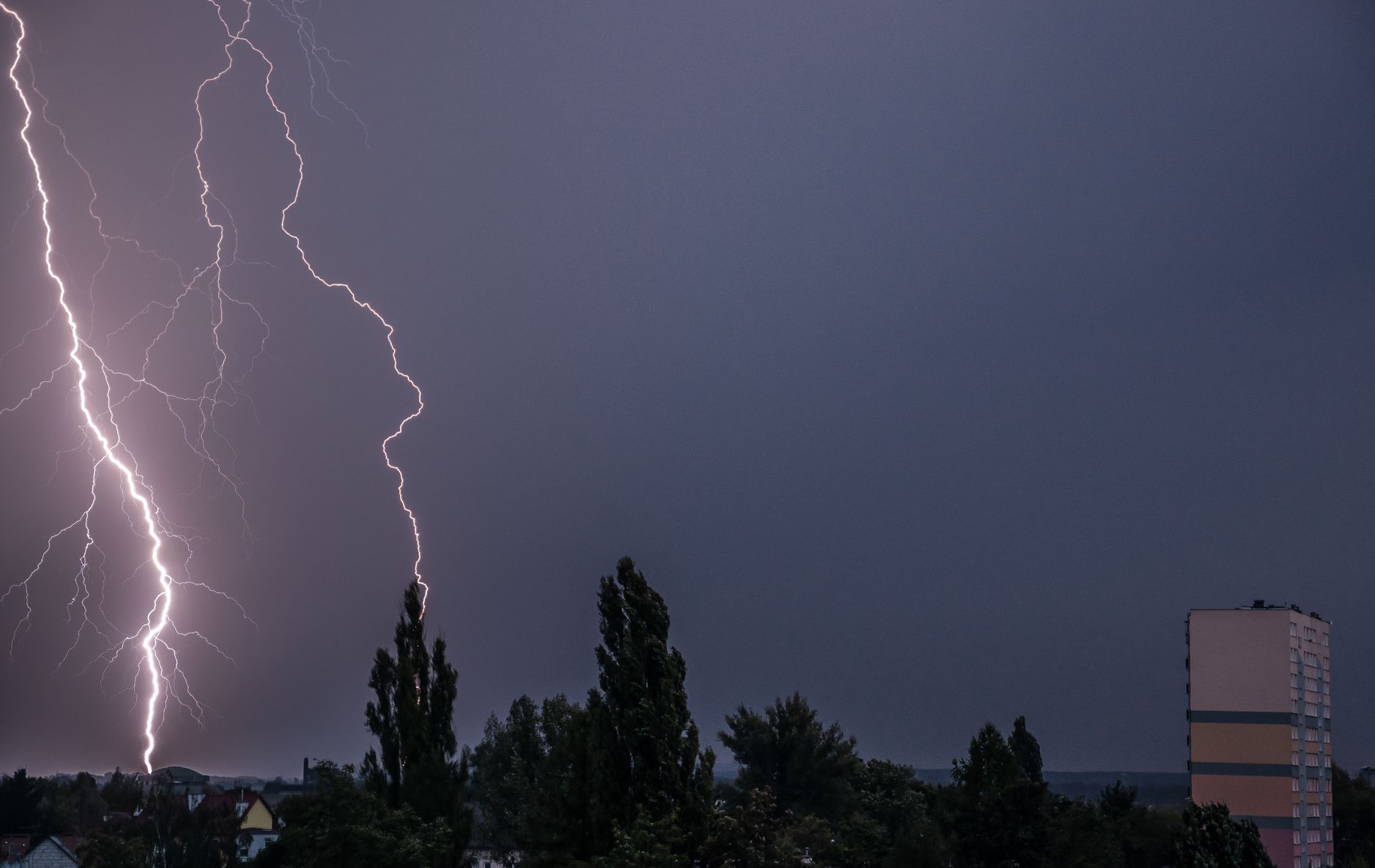
"Most people assume lightning strikes down from clouds to earth. The reality is more complex. While the initial stepped leader does descend from the cloud, the actual bright lightning stroke we see travels upward from the ground. When a leader approaches the surface, objects on the ground (trees, buildings, even people) send up streamers of positive charge to meet it. The connection between upward streamer and downward leader completes the circuit, and then the return stroke races upward at roughly one-third the speed of light. This return stroke is what illuminates the entire channel and what we perceive as the lightning bolt. The distinction matters for safety. Tall structures like skyscrapers and radio towers are struck frequently because they're more likely to send up strong streamers that connect with descending leaders. Ground-based lightning protection systems exploit this principle, using tall rods and conductive paths to intercept the upward streamer before it reaches the main structure. So in a sense, the ground is actively reaching up to meet the lightning, not passively receiving it from above."

Jul 20, 202600
Lightning Strikes the Same Place Twice (And More Often Than You'd Think)
Extreme Weather
#lightning#extreme weather#meteorology
Lightning Strikes the Same Place Twice (And More Often Than You'd Think)

"The old saying that lightning never strikes the same place twice is backwards. Lightning actually tends to hit the same locations repeatedly, which is why tall structures like the Empire State Building get struck about 20 to 25 times per year on average. The building's height and conductive materials make it an attractive target for electrical discharge, and this pattern holds true for other prominent landmarks and geographic features. Mountains, water towers, and isolated trees all experience repeated strikes because lightning follows the path of least electrical resistance. What makes this stranger is that the ground itself matters. Certain soil compositions and geological formations create preferred pathways for current, turning specific spots into lightning magnets. This is why meteorologists can predict high-strike zones with reasonable accuracy. The risk to humans remains genuinely low because we're usually not the tallest or most conductive object in our surroundings, but understanding this behavior has real consequences for infrastructure design and safety protocols. Engineers deliberately place lightning rods on buildings to channel strikes away from inhabited spaces, essentially sacrificing one spot to protect the whole structure. So lightning doesn't avoid repetition, it embraces it, returning to the same targets again and again like a persistent electrical storm with a long memory."

Jul 17, 202600
Lightning Can Strike the Same Place Twice, and Often Does
Extreme Weather
#lightning#extreme weather#storms
Lightning Can Strike the Same Place Twice, and Often Does

"The old saying that lightning never strikes the same place twice is backwards. Lightning actually does strike the same location repeatedly, sometimes within seconds. The Empire State Building gets hit about 20 to 25 times per year, and the Eiffel Tower experiences similar frequency. This happens because lightning follows the path of least electrical resistance, and tall structures in open areas create ideal conditions that don't change much between storms. A lightning strike leaves the ground ionized and conductive for a brief window, making it more likely to be struck again. The tallest, most exposed objects in a landscape act like magnets for electrical discharge. What's more surprising is that a single lightning bolt isn't actually a single stroke. Most lightning events consist of multiple strokes hitting the same channel in rapid succession, which is why the light flickers. Understanding this has practical importance for infrastructure design and safety protocols. Buildings and structures in exposed locations require robust grounding systems precisely because they will be struck multiple times throughout their existence. The repeated strikes on famous landmarks haven't destroyed them only because of careful engineering and maintenance. This fact upends the folk wisdom many people learned as children and shows why tall buildings need lightning protection systems designed to handle repeated impacts, not just occasional ones."

Jul 16, 202600
Lightning Can Strike the Same Place Twice, and Often Does
Extreme Weather
#lightning#weather phenomena#electrical storms
Lightning Can Strike the Same Place Twice, and Often Does

"The Empire State Building gets struck by lightning about 20 to 25 times per year. This destroys the myth that lightning never strikes the same location twice. In reality, lightning follows the path of least electrical resistance through the air to the ground. Tall structures with good conductivity become natural targets, making repeat strikes not just possible but likely. The reason this surprises people comes partly from an old saying that has no scientific basis. Lightning simply doesn't care about superstition. If you're the tallest point in a flat landscape, or a prominent structure in a city, electricity will take that route repeatedly whenever conditions align. Rod Serling, the creator of The Twilight Zone, was struck twice in his lifetime. Golfer Roy Sullivan was hit seven times between 1969 and 1977, surviving each strike but suffering serious injuries. These aren't flukes. They're statistical inevitabilities for people or objects that spend time in exposed positions during storms. The danger varies depending on whether you're indoors or outdoors, how well grounded a structure is, and how frequently storms pass overhead. But the core fact remains: lightning absolutely can and does strike the same place multiple times. It's predictable, measurable, and happens constantly in cities around the world."

Jul 14, 202600
Lightning Strikes Can Turn Sand Into Glass Tubes
Extreme Weather
#lightning#fulgurites#extreme weather
Lightning Strikes Can Turn Sand Into Glass Tubes

"When lightning strikes sandy beaches or desert ground, the extreme heat—reaching approximately 30,000 Kelvin (53,540°F)—instantly melts the silica in sand. This creates hollow glass tubes called fulgurites that can extend several meters deep into the earth. These natural glass formations are rare and fragile, shattering easily, yet they provide scientists with a visible record of lightning strikes. Fulgurites have been found on every continent and offer insights into historical lightning patterns and soil composition. The phenomenon was first scientifically documented in the 18th century, though fulgurites have existed as long as lightning itself. Some specimens are perfectly preserved and have become sought-after geological curiosities. The largest fulgurites ever recorded measured over 15 feet in length. These glass tubes demonstrate the incredible power of lightning—a single strike releases more energy than a ton of TNT. Interestingly, fulgurites occasionally contain trapped air pockets and mineral deposits, making each one geologically unique. While most fulgurites are found in sandy environments, they can also form in other materials like soil or even tree roots. This striking example of nature's extreme weather creating permanent geological formations reminds us of the raw power contained within a single lightning bolt."

Jun 29, 202600
Lightning Strikes Create Glass Sculptures Underground
Extreme Weather
#lightning#extreme weather#geology
Lightning Strikes Create Glass Sculptures Underground

"When lightning strikes sandy soil or sand dunes, the extreme heat—reaching 30,000 degrees Fahrenheit (16,650°C), hotter than the sun's surface—instantly fuses sand particles into a glassy crystalline structure called fulgurite. These hollow glass tubes can extend 10 to 15 feet deep into the earth, preserving the exact path of the lightning bolt like a frozen moment of nature's most violent fury. Fulgurites are typically branching formations with a sandy interior coating and a glassy exterior shell. Scientists have discovered fulgurites that are thousands of years old, providing geological records of ancient lightning patterns. These formations are rare enough to be treasured by collectors and researchers alike. The process happens so quickly that the sand transforms from solid particles to fused glass in mere microseconds. Fulgurites have even been found on other planets—NASA researchers discovered them during lunar expeditions, proving lightning and sand interactions occur beyond Earth. Each fulgurite is completely unique, with its own branching pattern determined by soil composition, moisture content, and the precise electrical path taken by the lightning discharge. These natural glass sculptures represent one of nature's most spectacular and unexpected transformations."

Jun 27, 202600
Lightning Can Create Glass Sculptures Underground
Extreme Weather
#lightning#fulgurites#extreme weather
Lightning Can Create Glass Sculptures Underground

"When lightning strikes sandy soil or sandy beaches, the extreme heat—reaching 30,000 Kelvin, hotter than the sun's surface—can instantly fuse sand particles into glass tubes called fulgurites. These hollow, branching glass formations can extend several meters deep into the ground, creating intricate natural sculptures that persist for thousands of years. The process happens so rapidly that the sand doesn't have time to melt uniformly; instead, it vitrifies along the lightning's conductive path, leaving behind a delicate glass mold of the electrical discharge itself. Fulgurites are hollow because the lightning vaporizes moisture and organic material inside the sand column, creating a void. These formations range from pencil-thin to several centimeters in diameter and can branch extensively as the electrical current seeks the path of least resistance through the ground. Scientists study fulgurites to understand lightning behavior and soil composition, while collectors prize them as rare natural wonders. The largest known fulgurite, discovered in Florida, extended over 16 feet into the ground. Because they're fragile and require specific conditions to form—sandy soil with sufficient moisture—fulgurites are relatively uncommon finds, making them remarkable geological specimens that represent nature's most violent weather events crystallized in glass."

Jun 19, 202600